
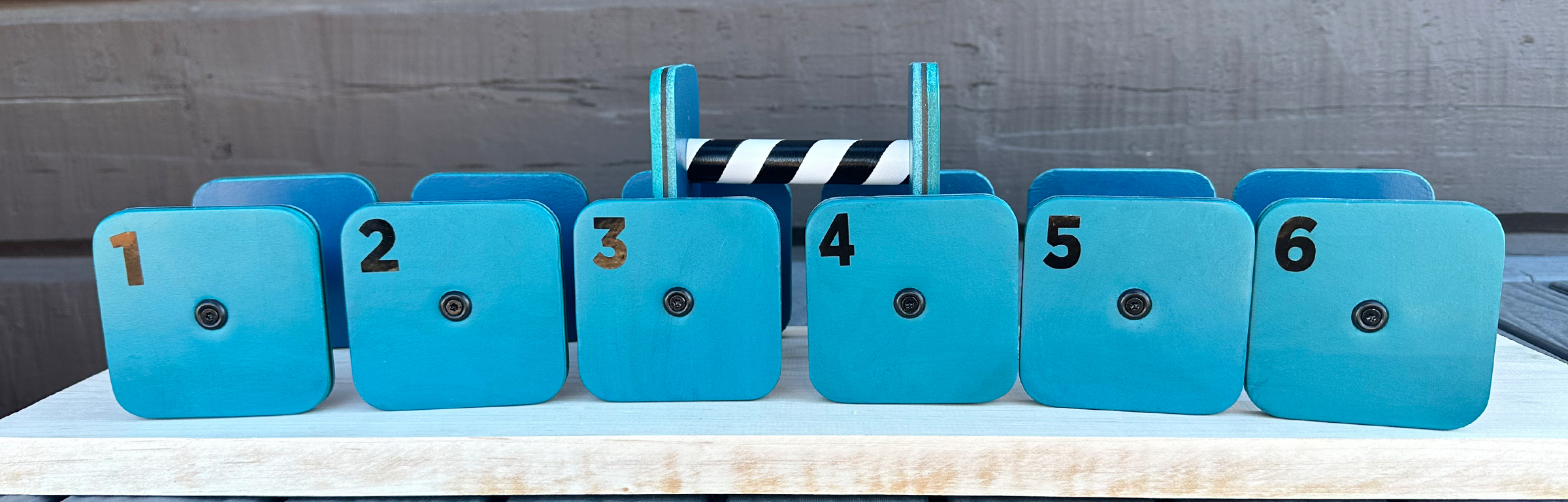
The broad jump exercise is more than simply jumping across some boards on the ground. Ideally, you want the dog to jump straight down the middle, yet not jump super flat, take one or two strides, then turn to come to front. These guides are the best tool I have come up with to help teach dogs my requirements for the broad jump.
The bases are made with solid, 3/4" steel pipe, which makes them perfect for indoors AND outdoors! The 12" acrylic rod in the center is removable for easy storing and transport. The guides include removable spring clips, which are used to hold a rod or pole for the dog to jump over. These clips allow whatever tool you use for the dog to jump over to fall easily it is hit by the dog. Or remove the clips and use the upright guides to pattern straight jumping from your dog.
Guide placement is dog specific, depending on what you are trying to accomplish. I normally place mine in between the broad jump boards, slightly past the center of the jump. They are especially valuable when you start proofing the broad jump in preparation of trialing.
For my dogs and my students' dogs, these guides are never faded in practice. While the bar will become as invisible as possible, I want the dog to always believe they are there. Perfect practice makes perfect!
The bases are made with solid, 3/4" steel pipe, which makes them perfect for indoors AND outdoors! The 12" acrylic rod in the center is removable for easy storing and transport. The guides include removable spring clips, which are used to hold a rod or pole for the dog to jump over. These clips allow whatever tool you use for the dog to jump over to fall easily it is hit by the dog. Or remove the clips and use the upright guides to pattern straight jumping from your dog.
Guide placement is dog specific, depending on what you are trying to accomplish. I normally place mine in between the broad jump boards, slightly past the center of the jump. They are especially valuable when you start proofing the broad jump in preparation of trialing.
For my dogs and my students' dogs, these guides are never faded in practice. While the bar will become as invisible as possible, I want the dog to always believe they are there. Perfect practice makes perfect!

Bases are completely hidden by the broad jump boards and the rods are barely visible to us…even less visible to your dog.


Use any style of "bar" for the dog to jump across - from very visible to almost invisible.
The bar should always be placed on the clips so that it will fall, without disrupting the uprights.
* No bars are included with broad jump guides *

cavaletti pole
very visible

extendable pointer stick
less visible

clear acrylic rod
almost invisible
To see one of my young dogs (10 months old) using the broad jump guides (old style, but same setup), please click below. In the first two reps, he is only jumping one board and the guides are set at the back edge of the board, with an additional one guide for him to wrap (you can also use a cone or other object here). In the second two reps, he is jumping two boards, with the guides between the two boards. With the older style, I used a string between the acrylic rods. However, I had some student dogs who because worried if they hit the string, so I switched to a bar that would fall if hit. In the video, the string height set a little lower than where it would be for an adult dog, but still higher than the boards, as he was relatively new to the broad jump.
